

Summer has a way of inviting us outward.
There are people to visit, places to see, long days to use well, and memories we hope our children will carry with them. While we are in Germany, it has felt especially important to say yes to family, friends, and places the children do not get to experience every day.
But I am also learning that every outing asks something of us.
Earlier this month, we traveled for a weekend. It was so much fun. But there was a lot of driving, and when we returned, it took several days for everyone to find their rhythm again. The first day back after a trip is often especially tense for us. The children are tired, the usual structure is gone, and the strain shows up quickly.
We notice it most in the mornings and late afternoons, especially when we are indoors. There is more roughhousing, screaming, fighting over toys, and “this is mine.” The easy moments when we naturally enjoy each other become harder to find.
The following weekend, we were ambitious again and drove several hours for a two-night stay. We hoped the children would sleep on the drive home, but alas only one of them did. By the time we arrived at our home base late at night, the awake one refused to go to bed and started screaming loud enough to wake up the whole house.
The next day, we visited relatives a shorter car drive away. The dysregulation started earlier and faster. It became difficult to finish even one sentence of adult conversation before we needed to separate the children and take one of them outside.
Being outside helps. It almost always does. But the calm did not hold for long.
By then, I felt overwhelmed. The screaming, crying, and intensity were frustrating, and it was hard for me to keep a cool head as their mother while everyone else was struggling to regulate too.
The trips themselves still mattered. We were seeing people we cared about and making experiences together. I would not call them mistakes. But it was clear that all of us needed a way back.
We had another overnight weekend planned after that. This time, we changed the plan.
It felt like giving something up at first. I had hoped to meet a friend I had not seen in years and to meet her young child for the first time. We tried to reduce the plan, and then even the adjusted version fell through.
But in talking, we realized that she was feeling some of the same strain. We both wanted the visit. We both tried. It simply was not the right moment.
Once the decision was made, I felt clarity and a wave of relief.
Instead of trying to rescue the original plan, we kept the part that still mattered to the children. They had been especially excited to ride an ICE train, one of Germany’s high-speed trains, so we took a simpler day trip with their great-grandma and great-grandpa.
It was not the weekend we had imagined, but it became its own small experience.
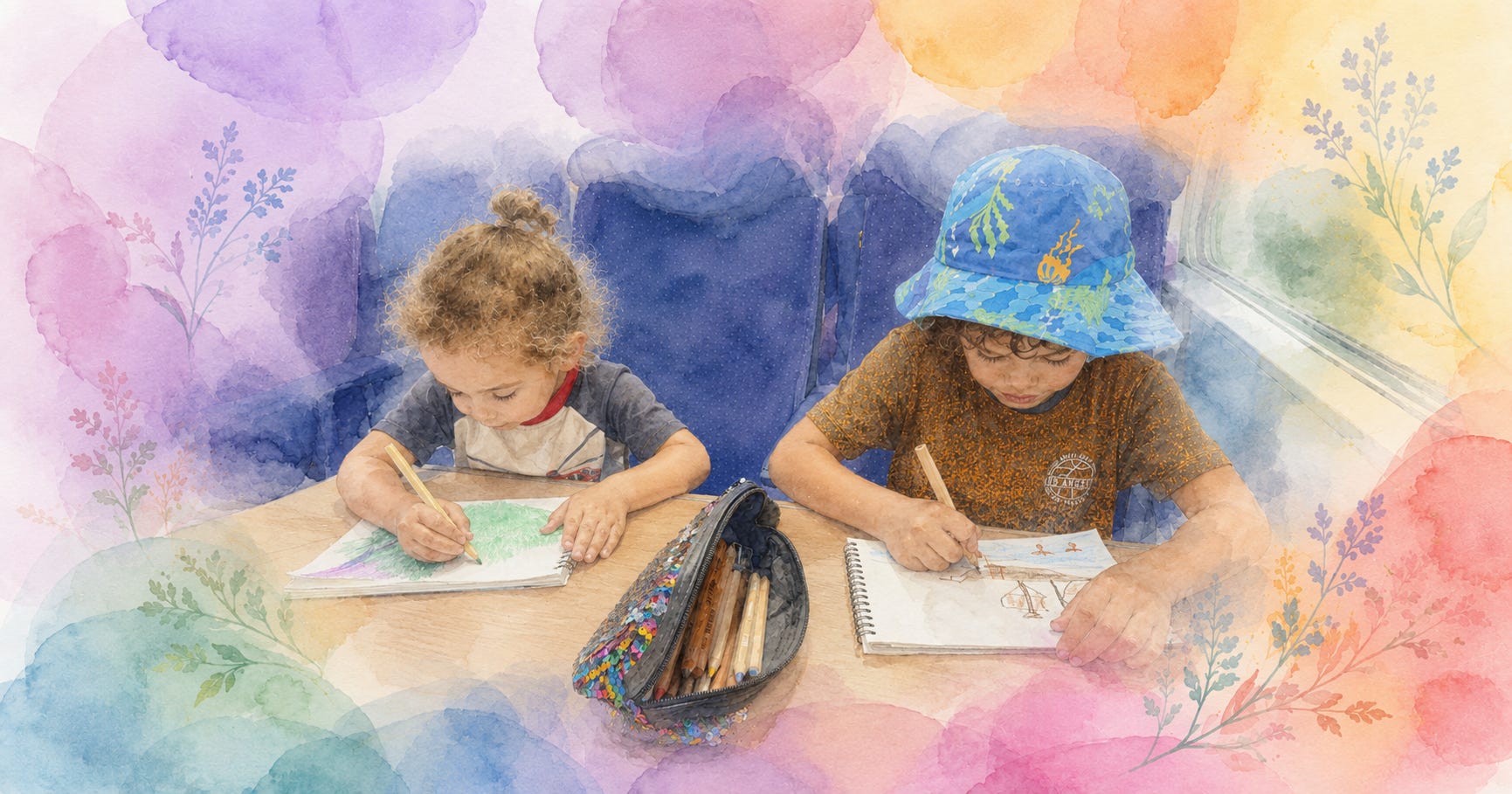
The children loved the speed of the train. They watched out the windows, spent time with their great-grandparents, and settled into something that has quietly become one of our favorite travel rituals.
We bring a spiral-bound coloring pad and a few good colored pencils. Our daughter, who is three, can sit and color for a surprisingly long time. Our son, who is seven, usually wants something more specific, so he and I choose a subject and draw it together.
Let’s both draw a boat.
Let’s both draw an island.
A large part of the train ride can pass this way, each of us bent over the page, drawing our own version of the same thing.
It is a very small practice, but it gives the children something familiar to return to while everything around them is moving.
That has been one of the lessons of this summer for me: flexibility is not the absence of rhythm.
Family rhythm does not have to mean following the same schedule every day. Even a full, adventurous summer needs a few dependable points of return. Sometimes it is simply one familiar thing that helps everyone know what comes next.
At Oma’s house, that point of return has often come in the form of an evening routine.
Luna has her bath first. Then I read to her and help her fall asleep while Devin has his bath with Oma. Afterward, I read to him and put him to bed.
These baths and stories have become their own small ritual here. They help the children settle after the day, and they help me settle too. That quieter time in the evening, after all the joyful and not-so-joyful noise, gives my own nervous system a chance to come down.
The mornings are not always calm, and certainly not perfect. But with a steadier evening rhythm, the children have had more capacity to regulate, and the calm sometimes holds a little longer as the consistency builds.
The beautiful moments have not always appeared during the biggest plans.
Sometimes they appeared when we stopped adding more.
They appeared while drawing boats on a train.
They appeared during a quiet bath at Oma’s house.
I still want us to go places, visit people, and say yes to meaningful experiences. But I am learning that a full summer also needs room to recover and a few familiar places to return to.
Flexibility has not meant giving up on the things that matter. It has meant letting go of the exact plan so that we can still find the connection inside it.
And changing a plan does not mean the plan failed. Sometimes it is the most caring response to what the family in front of you actually needs.
This week, choose one familiar point in the day that your family can return to. It might be a bath and a story, drawing together, a walk after dinner, fruit at the table, or the usual bedtime sequence.
It does not need to fix the whole day.
It only needs to help everyone begin to settle.
And if a plan is asking more of your family than you can give right now, you are allowed to change it without guilt.
What small rhythm helps your family feel like itself again? Hit reply and tell me. I would love to hear what you return to.
Find more from Small Moments · Full Life at smallmomentsfulllife.com.
The resource library is still growing, with more practical ideas and starting points being added over time.