I have spent an unreasonable amount of time thinking about page counts.
And margins. And cover dimensions. And copyright pages. And whether the image I am looking at is actually the final image, or merely a file that at some point was named final.
This is not the romantic part of making a book.
This is the part where you discover that after the writing and drawing and translating and editing and imagining, there is still a surprisingly large distance between I made this and someone can actually hold it in their hands.
Amazon’s publishing rules add another layer: at the moment, Kindle Direct Publishing allows up to two new titles to be created and two new titles to be submitted per format each week. Those are separate limits, which means three or four books do not necessarily go through together just because they are ready at the same time.
Then there are the print proofs. A listing can be live before you have held the finished book and checked the actual paper, color, margins, and binding. That last physical check is still ahead of me.
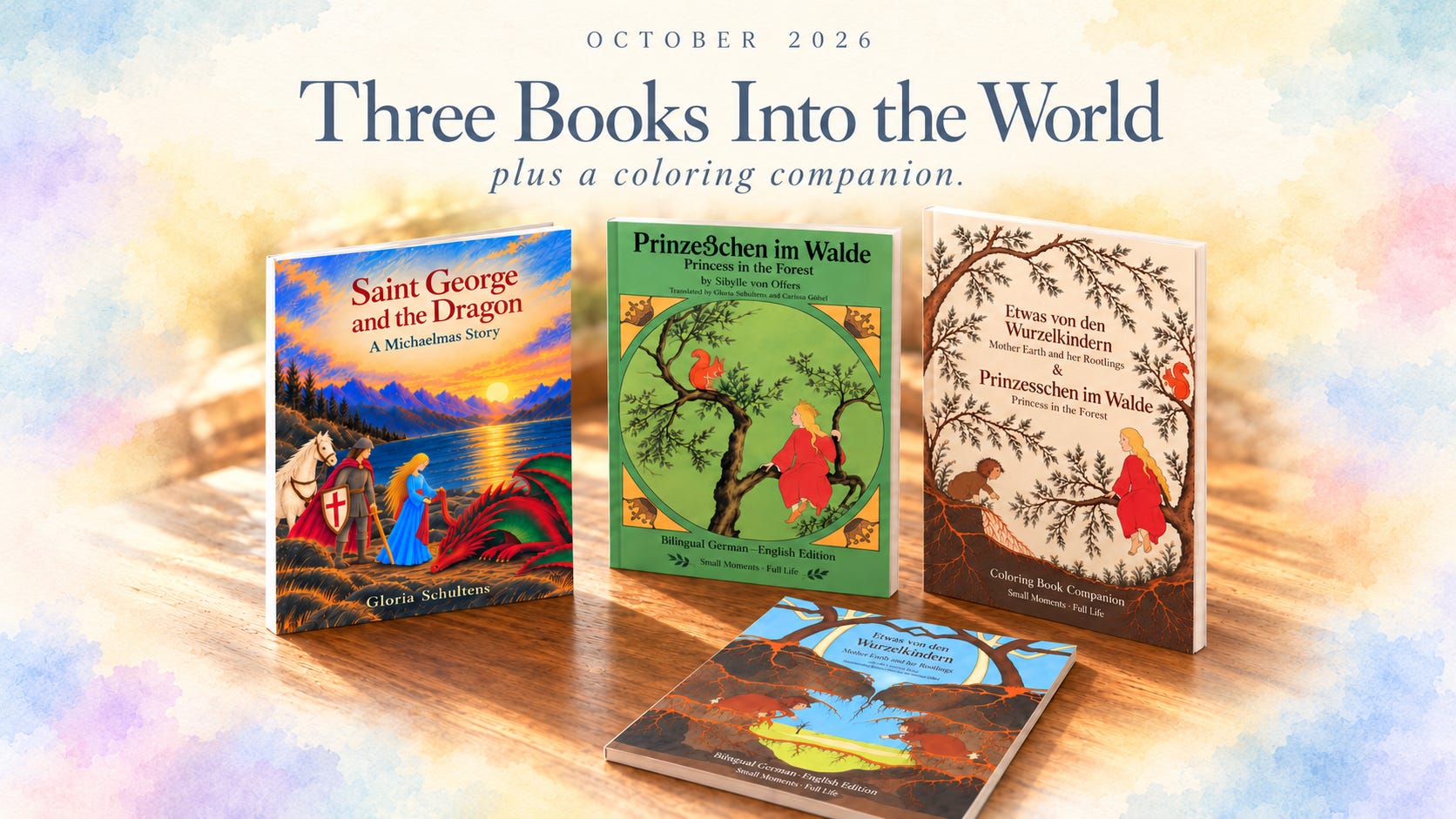
Three storybooks are now listed, along with a coloring-book companion. The coloring book is connected to the two older German stories, and it became another project of its own.
Two of the storybooks are stories I have known for a long time.
Etwas von den Wurzelkindern and Prinzesschen im Walde were written and illustrated more than a century ago by Sibylle von Olfers. They belong to that particular world of old German children’s books where flowers walk around in dresses, the forest is populated by little people, stars come down at night, and nature feels completely alive.
I grew up between German and English, and years ago my mother and I started translating these books together.
Not word for word.
That turns out not to be especially helpful when the original is written in rhyme and meant to be read aloud to a child.
We would go back and forth over a line: What is she actually saying here? What image matters? Can it still rhyme? Does it sound ridiculous in English? Does it still feel like the same little world?
I kept working on those translations afterward, revisiting rhythm and language and comparing versions until they felt like something I could actually read aloud.
I put the German and English together in new bilingual editions, while trying to disturb the original books as little as possible.
That has been one kind of creative work:
Preserve the thing.
Keep the original art. Keep the German. Repair what time and reproduction have damaged. Make the English live beside it without pretending it was always there.
Saint George has been almost the opposite.
I started with an old story that has been told and retold for centuries and asked what I wanted my children to receive from it.
I wanted courage. I wanted strength. I wanted Michaelmas.
But I did not really want a story whose final answer was simply that the dragon had to die.
So the story changed as I worked on it.
George still fights.
The Princess still walks toward something terrifying.
The dragon is still very much a dragon.
But the victory is not annihilation.
The dragon yields. The Princess leads it home. And eventually the same strength that destroyed the valley is put to work repairing it.
That book asked a different question:
What is the part of an old story worth carrying forward, and what needs to be told again?
And somewhere between these three books, I have been thinking about how often we are doing exactly this in family life.
We inherit things.
Stories. Songs. Recipes. Holidays. Beliefs. Little phrases our mothers said. Ways of celebrating. Things our grandparents did that somehow became things we do too.
Some deserve to be carefully preserved.
Some need translating.
Some need changing.
And sometimes the most loving thing we can do with an old tradition is neither to reproduce it perfectly nor throw it away.
It is to ask:
What is alive in this?
What do I want to carry with me?
What can I let change?
That may be why these books feel at home inside Small Moments · Full Life.
I do not really want to create a museum of beautiful childhood things.
I want to keep finding ways for beautiful things to remain living things.
Things we can Read. Make. Change. Carry. Give to someone else.
And then, eventually, stop adjusting the margins and actually put into the world.
So that has been the final stretch.
Three books open on my computer.
A slightly absurd number of files.
And now, three stories ready for someone else’s bookshelf. With a coloring companion beside them, and print copies still to check.
The three storybooks and the coloring companion are available here!
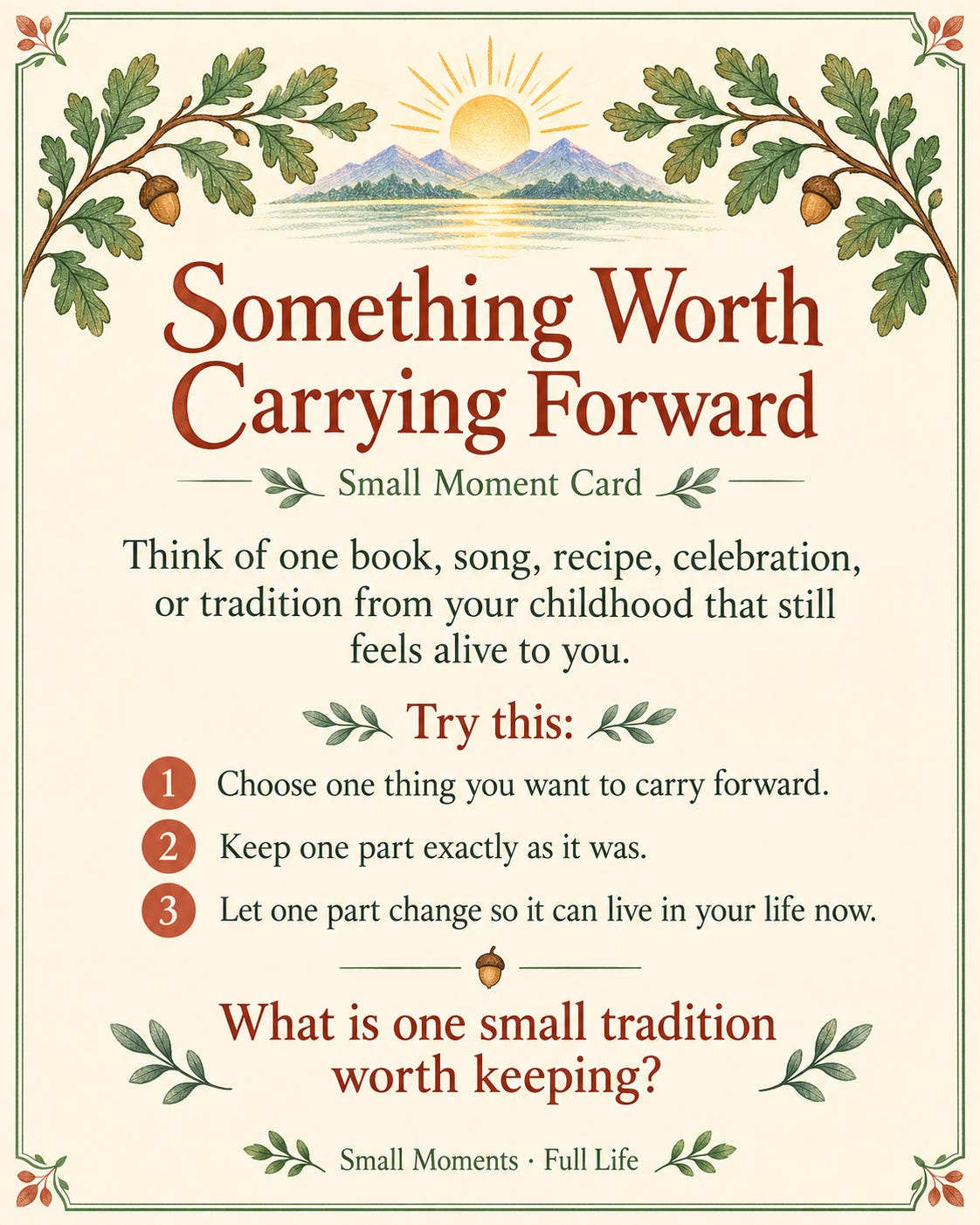
Here is your Moment Card :)
XOXO
Gloria
Is there a book, song, recipe, celebration, or tradition from your own childhood that you would like to carry forward? And if there is, what part of it would you keep exactly as it was?